The Evaluation and Report Language (EARL), from w3.org, is a "machine-readable format for expressing test results" in a framework-agnostic manner. While working on the rdfkit-go module, I wanted to build these reports for some of the common, public test suites that I was already testing against. So, I have been experimenting with a small earltesting package to generate these reports from Go test cases.
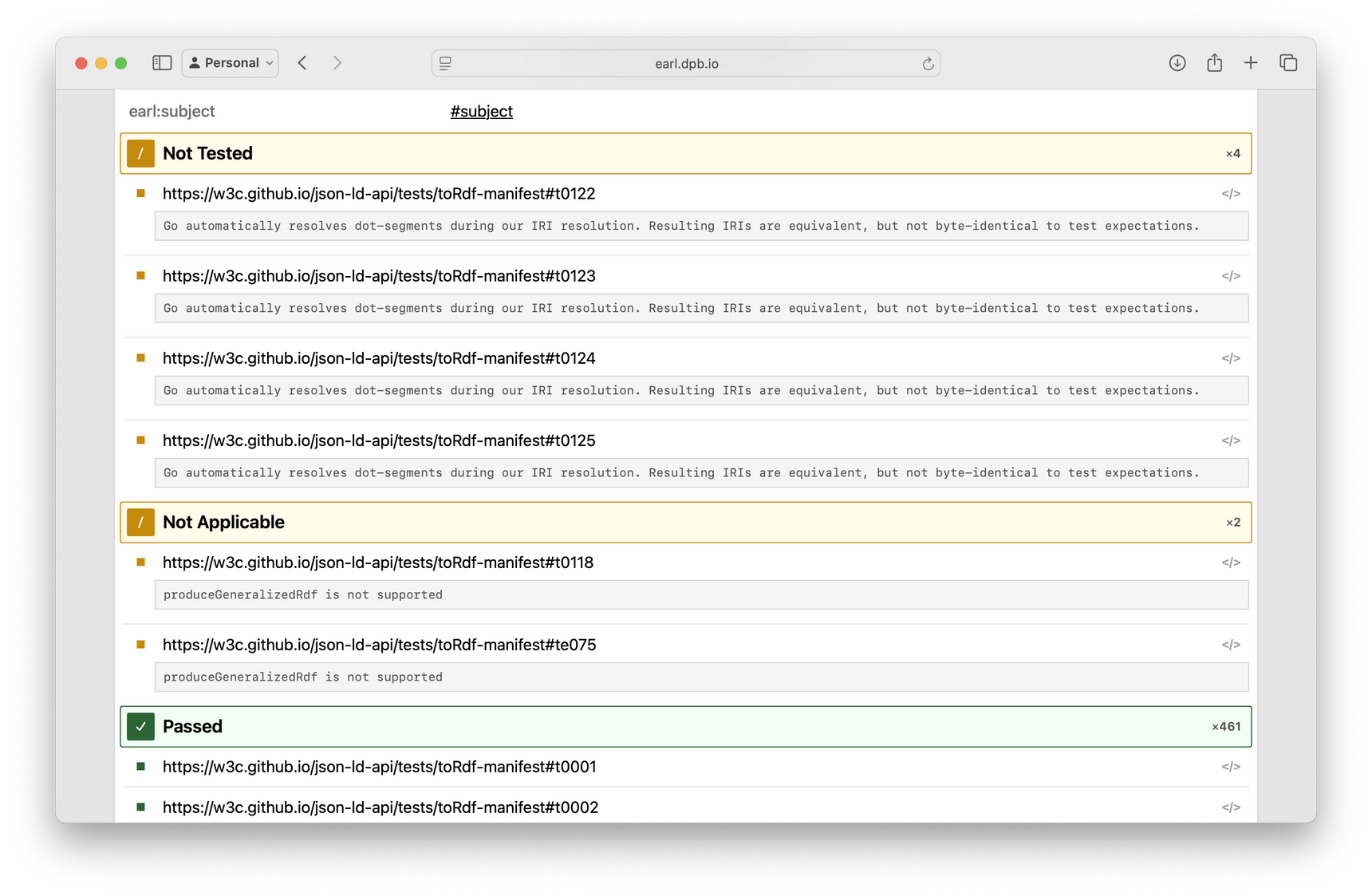
import "github.com/dpb587/rdfkit-go/ontology/earl/earltesting"This post shows how the w3c-github-json-ld-api-toRdf package uses earltesting to build an EARL Report for the Deserialize JSON-LD to RDF algorithm based on the public Test Suite published by JSON-LD.
Terminology
As a general purpose solution, EARL Reports use a few extra terms compared a traditional Go test. They are formally defined in the EARL 1.0 Schema, but here is a summary:
- Assertor - describes the who or what that is carrying out a test. In Go, I base this on the package performing the test, and typically use a separate package for public test suites.
- TestSubject - describes what is being tested against. In Go, I base this on the package being tested.
- Test - identifies the criterion being evaluated. In Go, I use subtests for these reports, and each descendant
t.Runrepresents a test. - Assertion - describes the context of the execution, evaluation, and result of an individual test.
- Outcome - categorizes the result of a test from a limited set of options. In Go, this maps from tests failing, passing, or, ambiguously, being marked as skipped.
Start a Report
Within a test, you can start a report with the NewReport function. At a minimum, the assertor and test subject should be configured. Any properties may be used, but the schema-recommended properties will look similar to the following.
func Test(t *testing.T) {
  earlReport := earltesting.NewReport(t).
    WithAssertor(
      rdf.IRI("#assertor"),
      rdfdescription.NewStatementsFromObjectsByPredicate(rdfutil.ObjectsByPredicate{
        rdfiri.Type_Property: rdf.ObjectValueList{
          earliri.Software_Class,
        },
        foafiri.Name_Property: rdf.ObjectValueList{
          xsdobject.String("rdfkit-go test suite"),
        },
        foafiri.Homepage_Property: rdf.ObjectValueList{
          rdf.IRI("https://github.com/dpb587/rdfkit-go/tree/main/encoding/jsonld/testsuites/w3c-github-json-ld-api-toRdf"),
        },
      })...,
    ).
    WithTestSubject(
      rdf.IRI("#subject"),
      rdfdescription.NewStatementsFromObjectsByPredicate(rdfutil.ObjectsByPredicate{
        rdfiri.Type_Property: rdf.ObjectValueList{
          earliri.Software_Class,
          rdf.IRI("http://usefulinc.com/ns/doap#Project"),
        },
        foafiri.Name_Property: rdf.ObjectValueList{
          xsdobject.String("rdfkit-go/encoding/jsonld"),
        },
        foafiri.Homepage_Property: rdf.ObjectValueList{
          rdf.IRI("https://pkg.go.dev/github.com/dpb587/rdfkit-go/encoding/jsonld"),
        },
        rdf.IRI("http://usefulinc.com/ns/doap#programming-language"): rdf.ObjectValueList{
          xsdobject.String("Go"),
        },
        rdf.IRI("http://usefulinc.com/ns/doap#repository"): rdf.ObjectValueList{
          rdf.IRI("https://github.com/dpb587/rdfkit-go"),
        },
      })...,
    )

    // ...
}
The With* methods update the current scope and any future EARL Assertions will reference the resources with the earl:assertedBy and earl:subject properties.
Annotating Test Cases
Each test case published by shared conformance tests are assigned a unique identifier, typically an IRI. The identifier helps ensure the results from independent reports can be correlated. The identifier is required when creating an EARL Assertion, but I also happen to use it for the Go subtest name.
for _, sequence := range testdataManifest.Sequences {
  t.Run(string(sequence.ID), func(t *testing.T) {
    tAssertion := earlReport.NewAssertion(t, sequence.ID)

    // ...
  })
}
Once created, a cleanup handler (via t) automatically captures the EARL Outcome of the test. That is, a failure becomes earl:failed, a success becomes earl:passed, and a skip becomes earl:cantTell. To force a specific outcome, use the SetTestResultOutcome method or, if appropriate, the Skip wrapper.
if sequence.Option.ProduceGeneralizedRdf {
  tAssertion.Skip(earliri.Inapplicable_NotApplicable, "produceGeneralizedRdf is not supported")
}
The Skip method requires an EARL Outcome value and optional log values which are also sent to the standard t.Skip(...) method. EARL Test Results do not have an explicit property for "log" data, so I record it in a dc:description property. The Error, Fatal, and Log family of methods are also supported which similarly record the log data, and then get sent to the standard t methods.
Personally, I only use assertion logging for messages that are expected to be user-facing and worth documenting, not generic failures or technical data dumps. For example:
if slices.Contains(sequence.Type, "jld:NegativeEvaluationTest") {
  _, err := decodeAction()
  if err != nil {
    tAssertion.Logf("error (expected): %v", err)
  } else {
    t.Fatal("expected error, but got none")
  }
}
Once a test case has finished, its report data will look similar to the following Turtle resource.
[]
  a earl:Assertion ;
  earl:assertedBy <#assertor> ;
  earl:mode earl:automatic ;
  earl:result [
    a earl:TestResult ;
    dc:date "2026-01-14T02:01:33Z"^^xsd:dateTime ;
    dc:description "produceGeneralizedRdf is not supported\n" ;
    earl:outcome earl:inapplicable
  ] ;
  earl:subject <#subject> ;
  earl:test <https://w3c.github.io/json-ld-api/tests/toRdf#t0118> .
Saving Reports
Reports do not have a default output. For now, it's easier to use the NewReportFromEnv function. This approach takes care of writing the report to a file once the test suite is complete, and it relies on the following environment variables.
TESTING_EARL_OUTPUT- file path, relative to the test package, for the N-Triples output. Or, if the file extension is.ttl, a Turtle file will be created.TESTING_EARL_SUBJECT_RELEASE_*- if non-empty, added to subjects under thedoap:releaseproperty. Intended for use when producing reports for tagged releases.TESTING_EARL_SUBJECT_RELEASE_NAMEfordoap:nameTESTING_EARL_SUBJECT_RELEASE_REVISIONfordoap:revisionTESTING_EARL_SUBJECT_RELEASE_DATEfordc:created
I use the env-configured approach which behaves similar to the following.
$ TESTING_EARL_OUTPUT=earl-report.ttl go test ./...
$ find . -name earl-report.ttl
./encoding/trig/testsuites/w3-2013-TrigTests/earl-report.ttl
./encoding/nquads/testsuites/w3-2013-N-QuadsTests/earl-report.ttl
./encoding/turtle/testsuites/w3-2013-TurtleTests/earl-report.ttl
./encoding/rdfxml/testsuites/w3-2013-RDFXMLTests/earl-report.ttl
./encoding/jsonld/internal/jsonldinternal/testsuites/w3c-github-json-ld-api-expand/earl-report.ttl
./encoding/jsonld/testsuites/w3c-github-json-ld-api-toRdf/earl-report.ttl
./encoding/ntriples/testsuites/w3-2013-N-TriplesTests/earl-report.ttl
./rdfcanon/testsuites/w3c-rdf-canon-tests/earl-report.ttl
Before committing them directly to version control, keep in mind that the reports include timestamps which change every time. I include the files in my .gitignore and treat them as build artifacts.
Publishing Reports
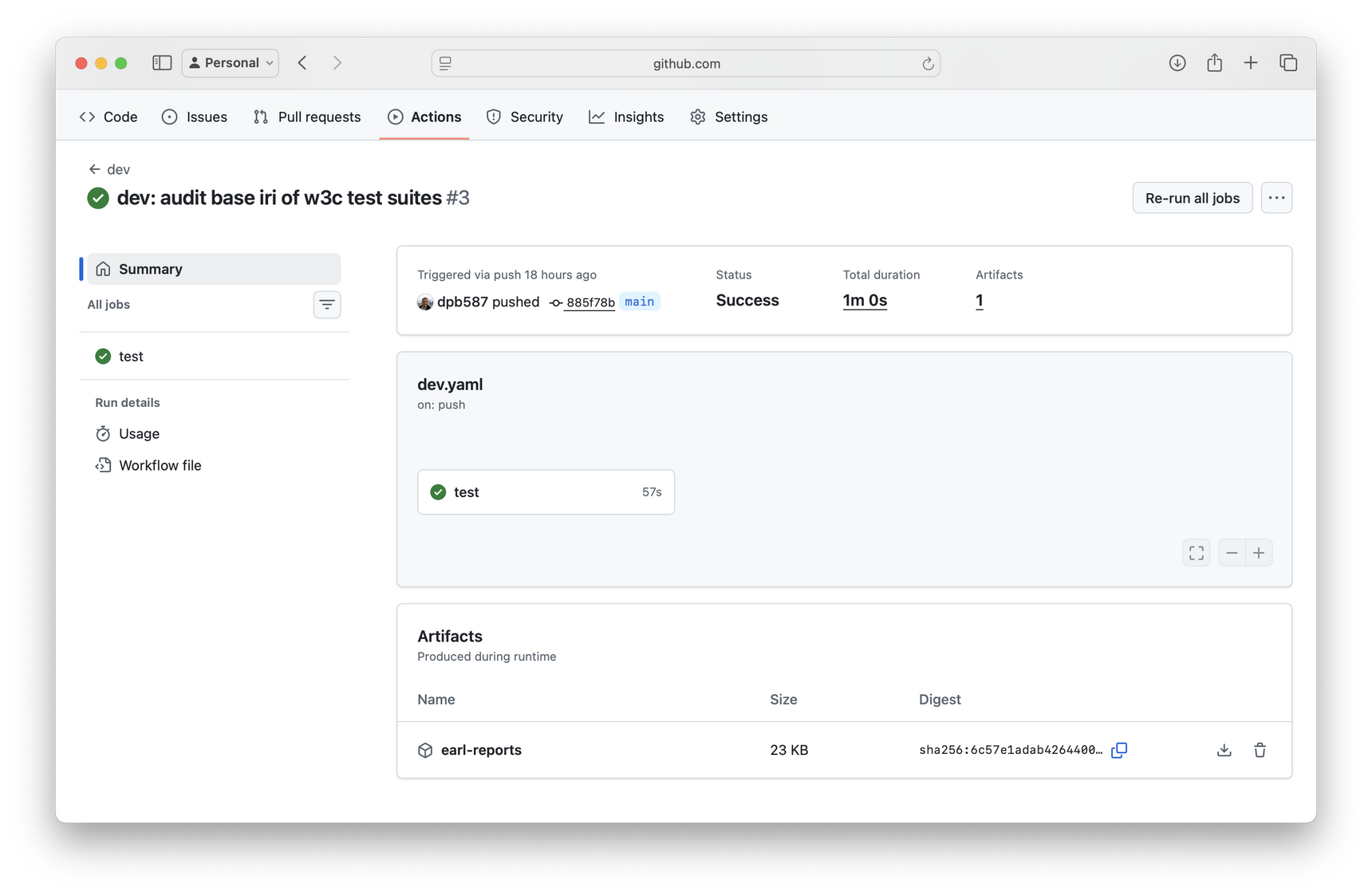
Since rdfkit-go is now using GitHub Actions, I have a test.sh step which collects all the EARL Reports, and then an upload-artifact step to retain them for a short period of time.
As a self-certification method, there is not really a central location to share results with. In practice, standards development tracks seem to rely on manually-aggregated reports to monitor community implementation before a standard is formally recommended. Once recommended, though, the reports may not be referenced or updated again.
In general, EARL Reports are a fairly niche mechanism of reporting, and they seem like a technical solution that few technical developers have a reason to care about. In theory, I think these reports (and the underlying, shared test suites) have more potential for discovering and evaluating software implementations across the web. I hope to experiment with more ideas about this in the future.
Comments